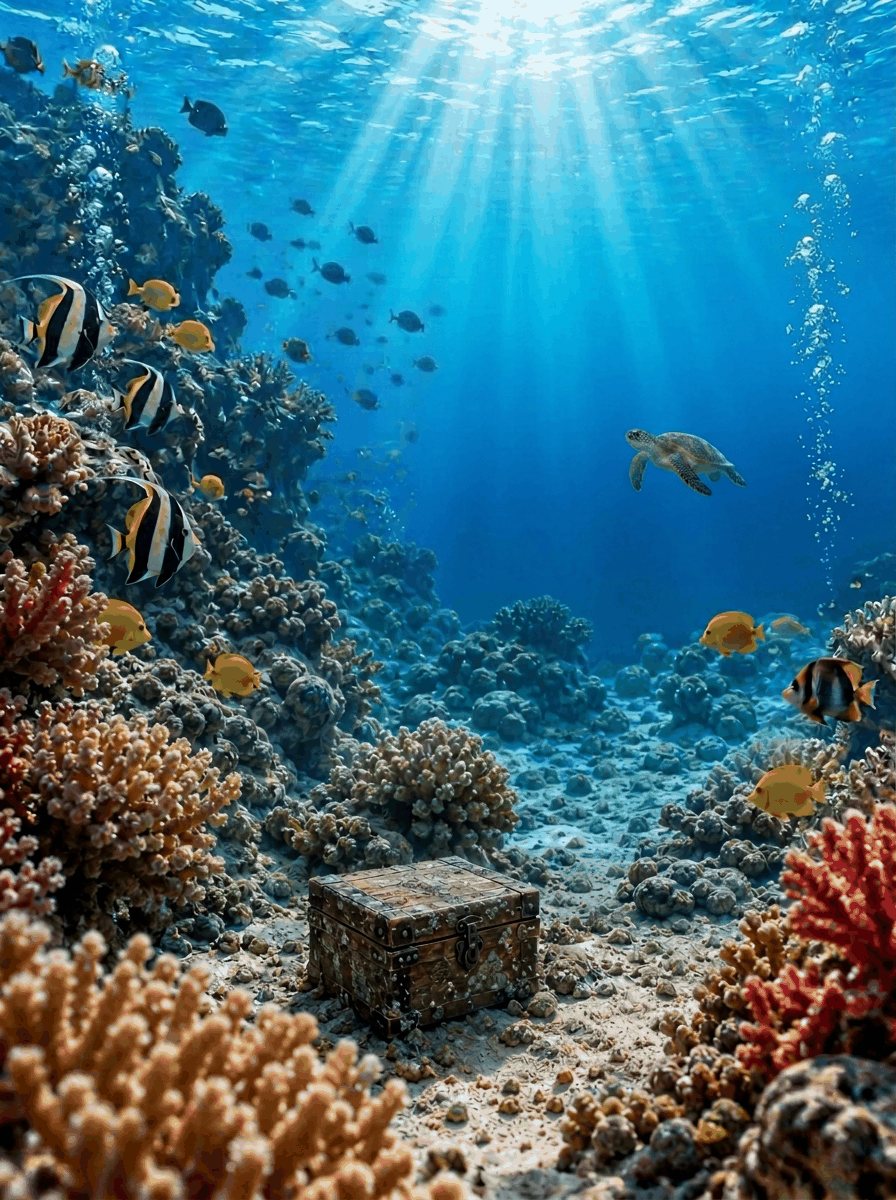
Hidden treasure
We built in some hidden treasures. The first one is behind the palm trees — press on the palm trees anywhere you see them in the app, and you'll find they work just like clicking ruby slippers to bring you home.
Beneath every puzzle you'll find two little stars, each with its own quiet gift.
The triple star on the left is Auto-Complete — press it and the puzzle solves itself, so you can relax and watch the pieces glide into place.
The single star on the right is Sneak Peek — a quick peek at the finished picture, whenever you'd like a hint.
Discover the Hawaiian Language
Another quiet discovery hidden in Pictaria is the beauty of the Hawaiian language. Scattered through the photographs and their stories are words worth keeping — names for flowers, waves, weather and the way people care for one another. Here they all are in one place, and where a word lives inside a photograph, you can tap it to go straight to that puzzle.
- ʻā
- Red-footed booby — a bright-footed ocean bird that nests in island trees above the surf.
- ahi
- Yellowfin or bigeye tuna — the deep-water fish at the heart of a poke bowl.
- ahupuaʻa
- A traditional land division running from the mountains to the sea, holding everything a community needed.
- ʻāina
- Land — and more than land: the earth that feeds and holds a people.
- ʻakiapōlāʻau
- A wondrous native honeycreeper with a dual-purpose beak — the straight lower bill pecks like a woodpecker while the curved upper bill probes for insects.
- akua
- God, goddess, spirit, the divine.
- ʻākulikuli
- Sea purslane — a salty, juicy succulent of the lava shoreline.
- aliʻi
- Chief, chiefess, royalty — the ruling class of old Hawaiʻi.
- aloalo
- Hibiscus — an open-hearted bloom that often lasts for just one radiant day.
- aloha
- Love, affection, compassion; also hello and goodbye — literally the sharing of breath.
- Aloha ʻĀina
- Love of the land — a deep ethic of care, respect, and responsibility for Hawaiʻi and the life it holds.
- ʻama
- The outrigger float that steadies a canoe — balance held beside the hull.
- ʻamakihi
- A bright yellow-green honeycreeper that thrives from coastal forests up to high volcanic slopes.
- ānuenue
- Rainbow — a near-daily event in the islands.
- ʻapapane
- A crimson native honeycreeper that feeds on ʻōhiʻa lehua blossoms.
- ʻaumakua
- A family guardian spirit, often appearing as a shark, owl, or turtle.
- ʻawa
- Kava — a ceremonial Pacific root traditionally prepared as a calming drink and shared with care and respect.
- ʻawapuhi
- Wild ginger; ʻawapuhi kuahiwi is the shampoo ginger used for hair and scent.
- ʻāweoweo
- Hawaiian bigeye fish — embers of rose-red that glow in the shelter of reef caves.
- ʻelepaio
- A spirited native monarch flycatcher with a perked tail, historically revered by canoe builders as an omen of sound timber.
- hāhālua
- Manta ray — a vast, gentle ocean flyer whose broad wings turn feeding into an underwater dance.
- hala kahiki
- Pineapple — literally “foreign hala,” because it resembled the native hala fruit.
- hale
- House, home, building.
- hale liʻiliʻi
- Little house — the raised, breezy beach cottage of old plantation Hawaiʻi, built for the trade winds more than for show.
- halulu
- Roaring, thundering — the sound of heavy surf.
- Hāna
- A cherished east Maui place reached by a winding rainforest road, where waterfalls, ocean cliffs, and quiet community life meet.
- hana
- Work, activity, craft — the good work of one's hands and days.
- Haleakalā
- House of the Sun — Maui’s great volcanic mountain, rising above Upcountry pastures, clouds, and dawn light.
- hapa
- Part, portion; commonly used for someone of mixed heritage.
- hāpuʻu
- A native tree fern that fills Hawaiʻi's wet upland forests.
- Hawaiʻi
- The Hawaiian Islands and their homeland — a place carried in language, culture, ocean, and land.
- hau
- Sea hibiscus — a useful coastal tree whose soft flowers and inner bark have long served healing, cordage, and canoe traditions.
- heʻe
- Octopus — the many-armed, color-changing thinker of the reef.
- heʻe mauli
- Day octopus — an intelligent reef wanderer whose changing colors and textures carry the living spirit of the shallows.
- heʻe nalu
- Surfing — literally “wave sliding.”
- heʻe pūloa
- Night octopus — a slender, long-armed hunter whose pale patterns brighten the reef after sunset.
- heiau
- A Hawaiian temple or sacred site, often built of stacked lava rock.
- hīhīmanu
- Spotted eagle ray — an elegant winged ray, white-starred and graceful in clear water.
- hinahina
- A silvery native beach heliotrope that flourishes beside salt, wind, and lava.
- hinalea
- The saddle wrasse — a bright blue-green, orange, and violet reef fish found only in Hawaiʻi.
- hōkū kai
- Starfish — literally “star of the sea.”
- honu
- Green sea turtle — a symbol of long life, peace, and safe navigation.
- hoʻokipa
- Hospitality; to welcome and host generously.
- hoʻomaha
- To rest, to take a break, to go on vacation.
- hula
- The dance of Hawaiʻi — a way of carrying story, chant, and memory.
- huli
- To turn or reverse — the repeated turning that gives huli huli grilling its name.
- humuhumunukunukuāpuaʻa
- Hawaiʻi's state reef triggerfish — literally “triggerfish with a snout like a pig.”
- ʻiʻiwi
- The scarlet honeycreeper, with a long curved bill made for lehua nectar.
- ʻiliahi
- Hawaiian sandalwood — a precious tree with fragrant heartwood.
- ʻilima
- The delicate flower of Oʻahu, once reserved for royalty; hundreds make one lei.
- ʻīlio
- Dog — the small companion who claims a chair, a lap, or a patch of warm sand.
- ʻīlioholoikauaua
- Hawaiian monk seal — literally “dog that runs in rough water,” a rare ocean neighbor who rests on warm sand.
- ʻiwa
- Great frigatebird — literally “thief,” a vast-winged master of the Pacific sky.
- kaʻa
- Car, wagon, anything that rolls — including a wood-paneled woodie full of surfboards.
- kāheka
- Tide pool — a small sea-filled basin in lava rock where sky, reef, and tiny lives gather between tides.
- kāhingoi
- Red ginger — a brilliant scarlet flower that rises like a torch from the tropical shade.
- ka lae
- The point — South Point on Hawaiʻi island, the southernmost cape of the islands and likely the first landfall of Polynesian voyagers.
- kai
- Sea, sea water.
- kala
- Bluespine unicornfish — a slender reef grazer crowned with a graceful horn.
- kalo
- Taro — the staple plant of Hawaiʻi and, in tradition, an elder sibling of the Hawaiian people.
- kālua
- To cook in an underground oven — the slow, smoky preparation that turns a shared meal into a gathering.
- kamani
- A shoreline tree whose nut gives a healing oil for skin and sore muscles.
- kapu
- Sacred, forbidden, off limits; the old system of law and restriction.
- keiki
- Child; also the shoot or offspring of a plant.
- kī
- Ti — a broad-leaved canoe plant used for wrapping, cooling, protection, and blessing.
- kī hōʻalu
- Slack-key guitar — literally “loosen the key,” the open, sweet-ringing sound of Hawaiian evenings.
- kiawe
- Mesquite tree — the thorny, shade-giving tree of Maui's dry leeward shores.
- kihikihi
- Moorish idol — a reef fish banded in black, white, and gold, trailing a long streamer fin like a banner.
- kiʻi
- Carved image or figure; the guardian statues at temple sites.
- kīkākapu
- Butterflyfish — bright, finely patterned reef fish that travel the coral in devoted pairs.
- Kīlauea
- Much-spreading — the erupting volcano of Hawaiʻi island, and the name of Kauaʻi's northern point where a lighthouse watches the seabirds.
- kioea
- A name carried by island shorebirds and remembered here for the far-traveling bristle-thighed curlew.
- kō
- Sugarcane — sweet, strengthening cane whose juice also softened the taste of bitter plant preparations.
- koʻa
- Coral — the living architecture of the reef, sheltering countless bright lives.
- koa
- The great native hardwood tree; the word also means warrior, brave.
- koaʻe ʻula
- Red-tailed tropicbird — the white ocean flyer whose scarlet streamers shine against the sky.
- koholā
- Humpback whale, who winters in Hawaiian waters to calve and sing.
- kokiʻo
- Native Hawaiian hibiscus — the forest's own bloom, opening wide in the mist.
- kokiʻo keʻokeʻo
- The fragrant white native hibiscus found only in Hawaiʻi.
- kokiʻo ʻula
- Native red hibiscus — a rare crimson flower of Hawaiʻi's mountain forests.
- kōkua
- Help, aid; to lend a hand.
- koʻokoʻolau
- A native healing herb whose golden flowers and leaves are traditionally steeped as a gentle restorative tea.
- kope
- Coffee — the morning cup, grown on the sunny volcanic slopes of Kona.
- kuawa
- Guava — an introduced fruit tree whose tender leaves became a familiar island tea for the stomach.
- Kula
- An Upcountry Maui district of cool air, open farms, lavender hills, strawberries, and broad views toward the sea.
- kuleana
- Responsibility and privilege — the care one is entrusted to carry for people, place, and community.
- kukui
- The candlenut tree, Hawaiʻi's state tree; its oily nuts were burned for light — a symbol of enlightenment.
- kūmū
- Hawaiʻi's endemic red squirrelfish — a scarlet ember of the reef whose glow, old stories say, guided fishermen home.
- lāʻī
- Ti leaf, used for wrapping food, blessing, and protection.
- lānai
- A roofed open porch — where island life actually happens.
- lauhala
- Woven hala leaves — gathered, prepared, and braided into enduring mats, baskets, hats, and gifts by practiced hands.
- lauʻīpala
- Yellow tang — a bright reef grazer whose lemon-gold schools carry sunlight through clear water.
- leʻaleʻa
- Joy, pleasure, delight — time enjoyed with a light and happy heart.
- lehua
- The blossom of the ʻōhiʻa tree, sacred to Pele.
- lei
- A garland of flowers, leaves, shells, or seeds — given, never bought for oneself.
- liʻiliʻi
- Small, little — the size of a plantation cottage and everything sweet about it.
- lilikoʻi
- Passion fruit, named for the Lilikoʻi area of Maui where it first took hold.
- limu
- Seaweed — a gathered food, with dozens of named varieties.
- līpoa
- A prized, sweetly scented edible seaweed.
- lomi
- To rub, press, or massage gently — a traditional way of bringing fresh ingredients together.
- lomilomi
- A traditional Hawaiian healing practice of nurturing, flowing touch, carrying cultural and spiritual meaning beyond massage.
- lūʻau
- A feast; from the young taro leaves cooked at such gatherings.
- lūkini
- Lemongrass — an introduced, lemon-scented garden grass brewed into a bright and soothing tea.
- mahalo
- Thank you, gratitude, admiration.
- mahimahi
- Dolphinfish — a swift, jewel-colored open-ocean fish prized at island tables.
- mahina
- Moon, month — the moon that steers planting, fishing and the turning of seasons.
- maiʻa
- Banana — a gentle food and a sacred plant of old Hawaiʻi.
- maile
- A fragrant forest vine and the most sacred lei, worn open-ended.
- makai
- Toward the sea — one half of how Hawaiians give directions.
- Makawao
- An Upcountry Maui town shaped by paniolo ranch culture, artists, small shops, and cool mountain light.
- Mākena
- Abundance — and the name of a beloved south Maui shoreline shaped by lava, sun, and sea.
- mālama
- To care for, tend, protect — as in mālama ʻāina, care for the land.
- mālie
- Calm, quiet, still, serene — without wind or disturbance.
- malu
- Shaded, sheltered, protected — the cool of a coconut grove at midday.
- maluhia
- Peace, quiet, serenity — the deep calm of a sheltered place.
- māmaki
- An endemic Hawaiian forest shrub whose red-veined leaves make a gentle, restorative, caffeine-free tea.
- māmane
- A native upland tree with golden pea-like flowers, food for the palila bird.
- mamo
- The Hawaiian sergeant damselfish — a bold little black-barred guardian of the sunny shallows.
- mana
- Spiritual power, life force, authority.
- manini
- Convict tang — a small striped reef grazer that travels through the shallows in shimmering schools.
- mangō
- Mango — the sweet of summer yards, ripening on backyard branches across the islands.
- manō
- Shark — for many families an ʻaumakua, a guardian.
- manu
- Bird.
- manu palekaiko
- Bird of paradise — a tropical blossom shaped like a bright bird poised for flight.
- manu-o-kū
- The pure white fairy tern, known for nesting gently on bare tree branches without building a nest.
- maʻo hau hele
- The native yellow hibiscus and state flower of Hawaiʻi — a clear golden bloom that opens for a day.
- Maui
- The Valley Isle — an island of green mountains, golden beaches, deep agriculture, and beloved local communities.
- mauka
- Toward the mountains — the other half of island directions.
- mauli
- Life, heart, or life force — the living essence carried within a being.
- meliʻa
- Plumeria — a fragrant flower of welcome, farewell, and warm island evenings.
- mīkana
- Papaya — the sunrise-colored fruit that helps digestion.
- moa
- Chicken — the bright, busy yard bird of island mornings; also the name carried by delicate native ferns used in traditional practice.
- moana
- The open ocean — vast, deep, and shining, beyond the shelter of the reef.
- moena
- A woven mat; figuratively used for a soft carpet of moss or fallen blossoms.
- mokihana
- The anise-scented berry of Kauaʻi, found nowhere else on earth.
- Molokini
- A crescent-shaped volcanic islet and marine sanctuary off Maui, known for clear blue water and sheltering reef walls.
- mōlī
- Laysan albatross — a wide-winged ocean voyager renowned for lifelong bonds and graceful flight.
- moʻo
- Lizard or gecko; in old stories, a powerful guardian spirit often connected with freshwater pools and hidden places.
- muheʻe
- The Hawaiian bobtail squid — a thumb-sized night hunter that carries its own glowing blue lantern.
- nahele
- Forest, grove, wilderness — the deep green woods where mists gather.
- naiʻa
- Dolphin — the spinner of island bays, whose golden leaps are joy made visible.
- nalu
- Wave, surf; also to ponder, to turn something over in the mind.
- nani
- Beautiful, lovely, glory.
- naupaka
- A coastal shrub with half-flowers, tied to a story of separated lovers.
- nēnē
- The Hawaiian goose and Hawaiʻi's state bird, adapted to life on volcanic slopes and alpine grasslands.
- Niʻihau
- The westernmost inhabited Hawaiian island, ringed by clear channels, deep ledges, and enduring cultural tradition.
- niu
- Coconut — food, drink, fiber and shade carried across the Pacific by voyaging ancestors.
- noio
- Black noddy — a dark, gentle seabird that gathers along cliffs and sea caves.
- noni
- Indian mulberry, a Polynesian-introduced medicinal plant.
- nohu
- The Hawaiian green lionfish — a feathery-finned scorpionfish found nowhere else on Earth.
- nūnū
- The trumpetfish — a slender hunter that disguises itself as a drifting branch.
- ʻohana
- Family, in the widest sense — blood, chosen, and community.
- ʻohe
- Bamboo, carried in by Polynesian voyagers for pipes, poles, and nose flutes.
- ʻōhiʻa
- The pioneer tree of Hawaiian forests, first to grow on new lava; its flower is lehua.
- ʻōʻili
- The fantail filefish — a pale, speckled oddity with a wide fan tail.
- ʻokika
- Orchid — a borrowed Hawaiian name for the many jewel-like orchids flourishing in island forests and gardens.
- ʻōlaʻi
- Earthquake.
- ʻōlena
- Turmeric, used as medicine, dye, and in ceremonial purification.
- one
- Sand; a sandy beach.
- ʻōpule
- The ornate wrasse — a reef jewel painted in emerald, pink, and blue filigree.
- ʻopihi
- A limpet clinging to wave-washed rock, gathered at real risk and treasured.
- pāʻani
- To play; a game.
- Pāʻia
- A beloved north-shore town whose name is often translated as “noisy” — lively with wind, waves, and gathering voices.
- pāʻina
- A small gathering, a shared meal — the quieter, everyday cousin of a lūʻau.
- pākuʻikuʻi
- The Achilles tang — jet black with a burning orange sail, Hawaiʻi's own blazing reef tang.
- pali
- Cliff, precipice — the great green walls of the islands.
- palila
- A golden-headed honeycreeper whose life is bound to the high-elevation māmane forests of Mauna Kea.
- paniolo
- Hawaiian cowboy — a rider, roper, musician, and keeper of island ranch traditions.
- Papahānaumokuākea
- The immense protected ocean realm of the Northwestern Hawaiian Islands — a sacred genealogy of islands, reefs, wildlife, and deep cultural memory.
- pau hana
- Finished with work — the island version of clocking out.
- pīkake
- Arabian jasmine, named for the peacock, Princess Kaʻiulani's favorite.
- pō
- Night — and, in old Hawaiʻi, the realm of gods and ancestors beyond the sunset.
- pōhaku
- Stone, rock — the patient bones of the islands.
- pōhuehue
- Beach morning glory — the pink trumpet vine that binds the sand.
- poi
- Pounded taro, the traditional staple food.
- poke
- To slice or cut — and the dish of cubed raw fish dressed with salt, limu, and shoyu.
- pono
- Righteous, balanced, in right relationship — doing what is correct.
- pōpoki
- Cat — the porch napper who follows the sun across the boards all afternoon.
- pōpolo
- Black nightshade — a traditional healing green with white star flowers and berries used only when fully ripe and correctly identified.
- pua
- Flower, blossom; to bloom.
- pua kalaunu
- Crown flower — the pale lavender, crown-shaped blossom beloved by Queen Liliʻuokalani.
- pua kenikeni
- The fragrant “ten-cent flower,” opening cream and deepening to sunset gold.
- pueo
- The Hawaiian short-eared owl, sacred and revered as a protective family ʻaumakua.
- puhi
- Eel, especially the moray eel — a watchful reef neighbor tucked into coral doorways.
- pulelehua
- Butterfly — wings of living color moving flower to flower through the warm garden air.
- pūloa
- Long or extended — a name that evokes the night octopus's graceful, far-reaching arms.
- pūpū
- Shells — small ocean treasures traditionally gathered with care for lei and adornment.
- puʻu
- Hill, cinder cone.
- taʻape
- Bluestripe snapper — a golden reef fish that gathers in brilliant, flowing schools.
- ʻuala
- Sweet potato — the forgiving, sustaining food of the dry lands.
- ʻuaʻu kani
- Wedge-tailed shearwater — an ocean-skimming traveler whose calls carry from nesting burrows after dark.
- ʻuhaloa
- A small golden-flowered plant whose bitter root and leaves were traditionally used to soothe a sore throat.
- uhu
- Parrotfish — the turquoise reef grazer that helps shape coral into sand.
- ʻukulele
- “Jumping flea” — the Hawaiian name for the little Portuguese guitar that became the sound of the islands.
- ʻulaʻula
- Red, scarlet — used for the vibrant plumage of native honeycreepers and the red-crested cardinal.
- ʻumekee
- Tamarind — the sweet-and-sour pod carried into Hawaiʻi long ago and loved by generations.
- ʻulu
- Breadfruit — the generous canoe tree whose nourishing fruit has sustained Pacific families for generations.
- ulua
- Large trevally — a powerful open-water fish, respected for its strength and gleaming presence.
- waʻa
- Canoe — the voyaging vessel that carried Polynesians across the Pacific.
- waʻa kaulua
- Double-hulled voyaging canoe — a vessel guided across the open ocean by stars, swells and ancestral knowledge.
- wahine
- Woman, wife.
- wailele
- Waterfall — literally “leaping water.”
- weke
- Goatfish — a golden reef fish that searches the sand with delicate chin barbels.
- wiliwili
- A native dryland tree with light wood once used for surfboards and fishing floats.